
Automation Extended
This page outline the nexus of ABB Ability™ History and Automation Extended - ABB's evolution of ABB's distributed control systems (DCS), delivered through the automation ecosystem, which consists of two securely integrated environments (the digital & the control environment) designed to support supervision, control and optimization of industrial processes.
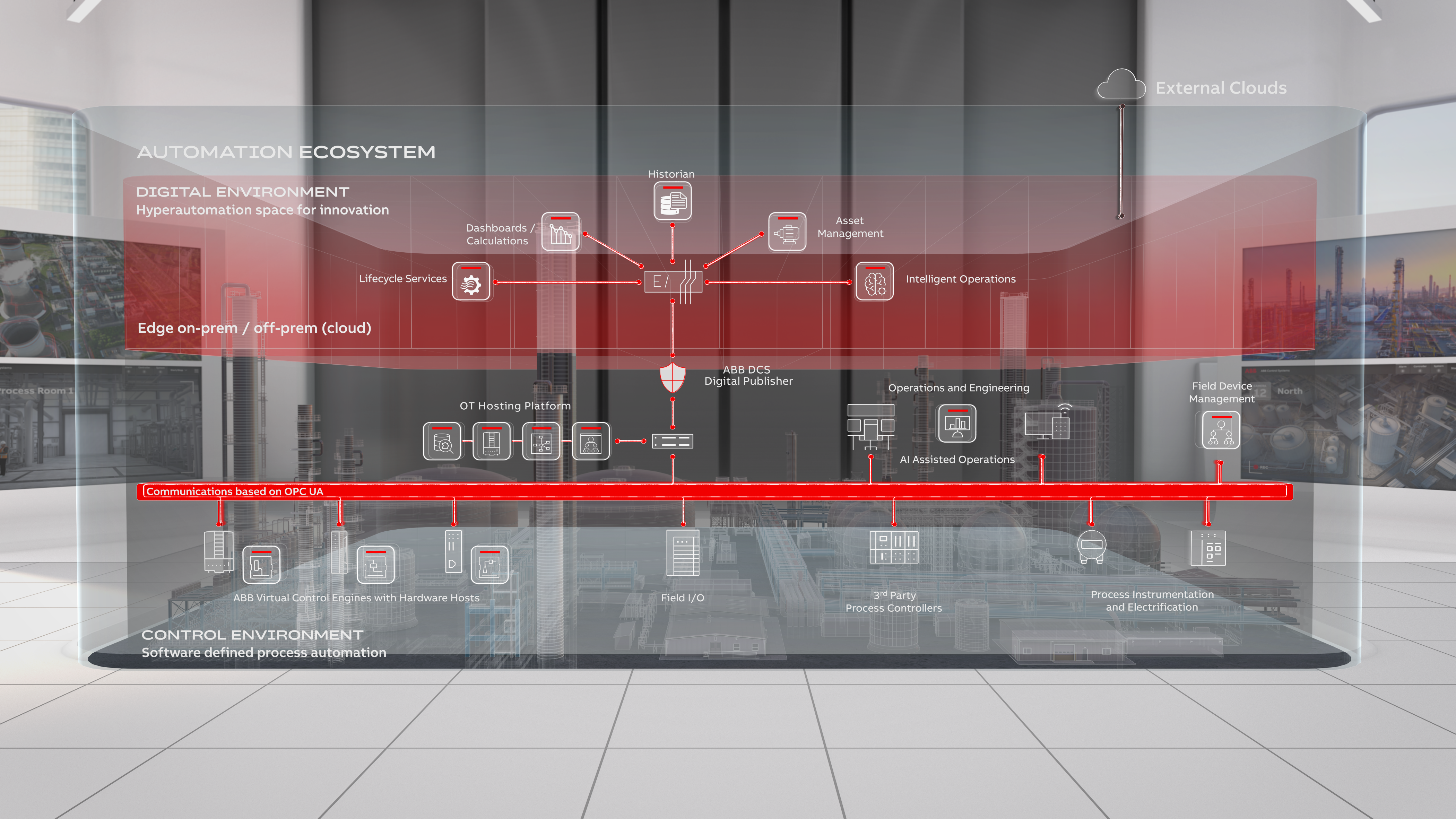
Automation Extended provides flexibility, scalability, and efficiency with future-ready, modular, and cyber-secure capabilities through an open, standards-based architecture. It integrates software-defined automation to ensure adaptability and performance for evolving needs. Automation Extended capabilities are delivered through ABB’s automation ecosystem. Built on the separation of concerns principle, this ecosystem has two securely integrated environments. One is a modular control environment, and the other is an extended environment for monitoring and optimising industrial processes.
Built on open standards and interoperable by design, Automation Extended enables customers to adopt innovative new capabilities while maximising value from existing systems and protecting long-term investment. Reflecting the principles of NAMUR Open Architecture, it enables intelligence at the edge and brings modular, data-driven automation into a secure, scalable environment.
In ABB’s automation ecosystem, the control and digital layers are maintained, updated, and optimised throughout their lifespan independently of each other. This separation allows updates to be applied without disrupting operations, enabling security patches, performance improvements, and technology upgrades at the right time for each layer. By managing these processes proactively, organisations keep systems reliable and secure, reduce the total cost of ownership, and remain ready for future innovations.
The Control Environment is where stable and reliable core process control is executed. This is the area most aligned to the traditional DCS in terms of function and requirements. It handles critical, real-time control operations without interruption. A combination of hardware and software configurations together with a network infrastructure delivering real-time, deterministic control that is designed to remain stable while prioritizing cyber secure operations.
Automation Extended represents the evolution of ABB’s systems, building on the legacy of proven, reliable control systems while introducing continuous innovation. It allows industries using ABB Ability™ System 800xA®, ABB Ability™ Symphony® Plus and Freelance, to adopt new capabilities gradually without disruption.
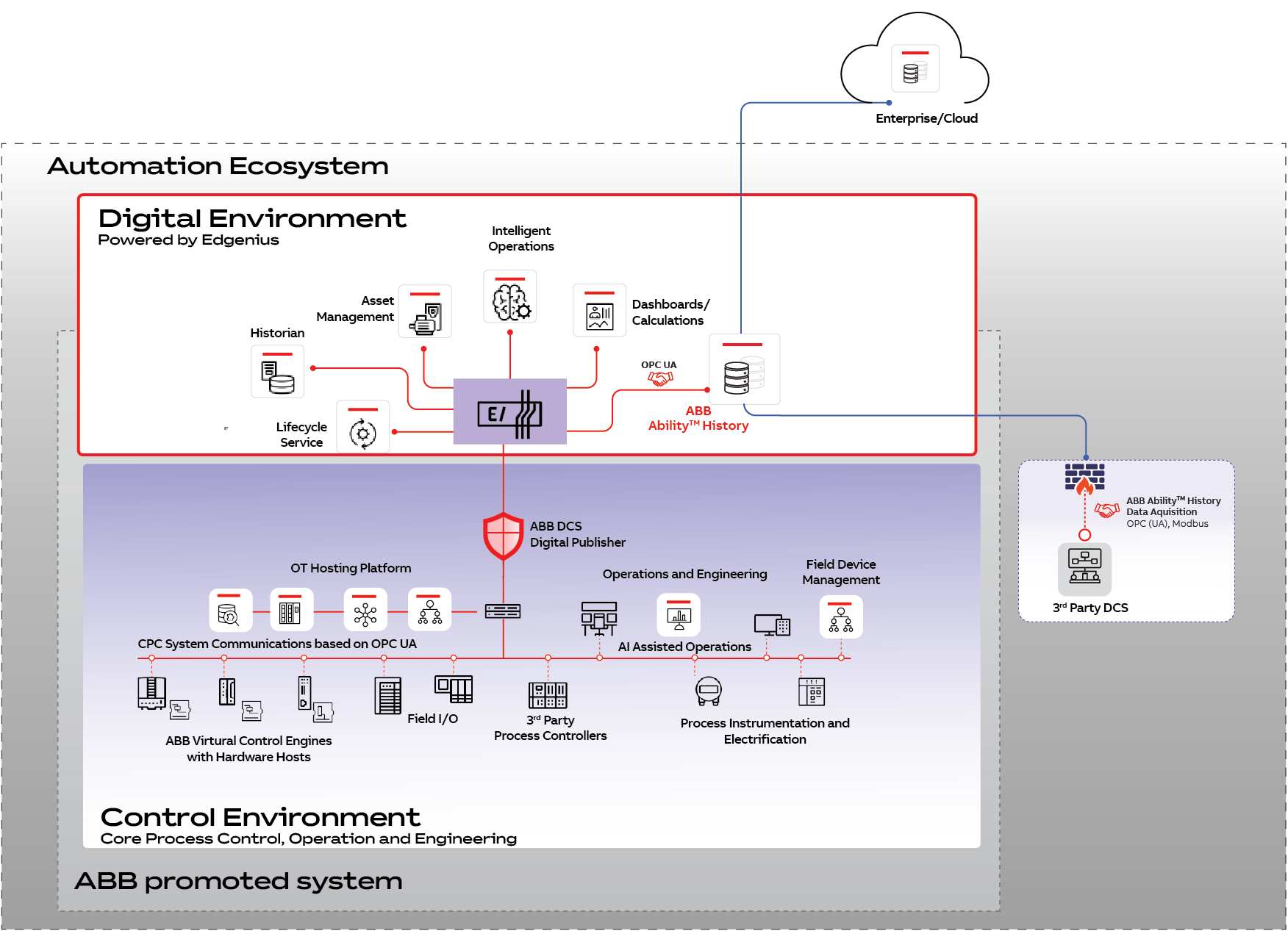
ABB Ability™ History is a key enabler of the Automation Extended ecosystem’s ability to ensure the integrity and security of systems and data, bridging control and cloud environments while allowing data to flow securely and efficiently across the systems. At the same time, lifecycle independence and agility are maintained. This, in turn, extends the reach of control systems beyond process control to include edge intelligence, real-time analytics, and AI-driven decision-making.
Automation Extended provides a flexible, modular environment where customers can add capabilities, update or remove applications, without affecting or interrupting core control. It operates independently from, while maintaining a symbiotic relationship with the Control Environment. Communication can be bidirectional, with most data published upward from the control layer, but advanced process optimisation in the extended layer can write setpoints to the control layer. This ensures the integrity and safety of the Control Environment while enabling analytics and optimisation in the extended layer.
The Automation Extended environment enables the deployment of the latest technologies and applications such as AI, condition monitoring, predictive maintenance, alarm management, augmented operator decision support, machine learning and remote operations, which in turn support ongoing digital transformation.
Lifecycle Services are integral to the automation ecosystem, ensuring that both environments evolve securely and sustainably over time. These services enable continuous updates, upgrades, and optimizations without disrupting critical operations, fully aligned with the principles of "separation of concerns."
ABB Ability™ History in Edgenius
ABB Ability™ History is a containerised application run on Edgenius OS and integrated with the Edgenius services. The application deployment uses Edgenius tooling, and the typical integration points with Edgenius services are user ID management and the OPC UA Server. Edgenius provides connectivity to ABB-promoted systems with its ABB DCS Digital Publisher and then makes the data available in its OPC UA Server.
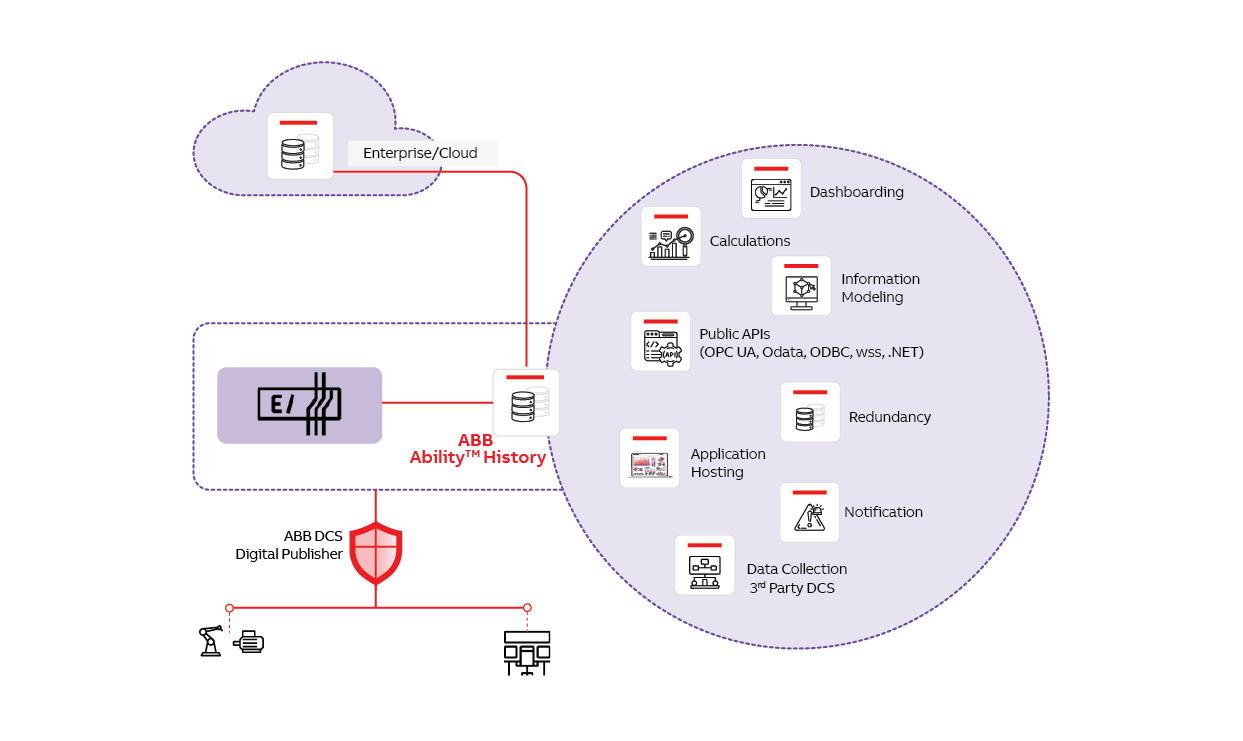
ABB Ability™ History connects to Edgenius OPC UA Server using the OPC UA Client autoconfiguration option to minimise engineering work. OPC UA Client autoconfiguration can subscribe to metadata from the OPC UA Server, create Equipment models, instances, and Tags/Variables according to the configuration, and then start subscribing to actual data and events.
ABB Ability™ History in Edgenius provides all the functionalities as it does in other environments. Data can be collected from multiple data sources, such as 3rd party control systems, stored and aggregated in the database, and it can be forwarded to other systems. The application development tooling enables implementation of equipment models, calculations, dashboards, notifications, and it is a hosting platform for ready-made applications.
ABB Ability™ History has been used in thousands of industrial systems where its robust architecture design provides the security, performance, and scalability that is needed from modern applications and data platforms. ABB Ability™ History can be installed as a high availability configuration on two independent Edgenius OS.
ABB Ability™ History provides rich functionality for Process Information Management (PIMS), Manufacturing Operations Management (MOM), Asset Performance Management (APM), Energy Management (EMS), and other similar industrial information systems. Powerful information modelling with industrial Low Code Application development tools ensure high productivity, good developer experience that result in good end user experience with web and mobile dashboards. A generic notification service allows users to subscribe to events in their preferred mobile application, such as WhatsApp.
ABB Ability™ History is an open platform for data sharing with standard open APIs such as OPC UA, OData, ODBC, and wss. Reading and writing data can be enabled for 3rd party systems and applications. Data, including metadata, can also be pushed to 3rd party systems with e.g. MQTT protocol.
Life-cycle support is facilitated with frequent releases of new features and with built-in multi-hop secure remote access.
ABB Ability™ History in Edgenius can be, for example, at the production line or plant-level system to launch applications for production monitoring and optimization, and it can act as a data gateway to cloud based enterprise level system where data from multiple plants are synced to support enterprise reporting and business intelligence. Data transport between the systems is bidirectional with automatic backfill, minimum engineering, and full redundancy support at all levels.
The Cloud/enterprise-level system provides all the same functionalities for development, applications, dashboards, open APIs, and the ability to feed data to 3rd parties. Automation Extended from control systems up to the cloud with minimum engineering and the separation of concerns principle.
800xA History Extended to Enterprise Data Platform
800xA History (version 7.0) can be extended securely with ABB Ability™ History to enable plant or enterprise-level systems where data is collected from multiple control systems and multiple plants together.
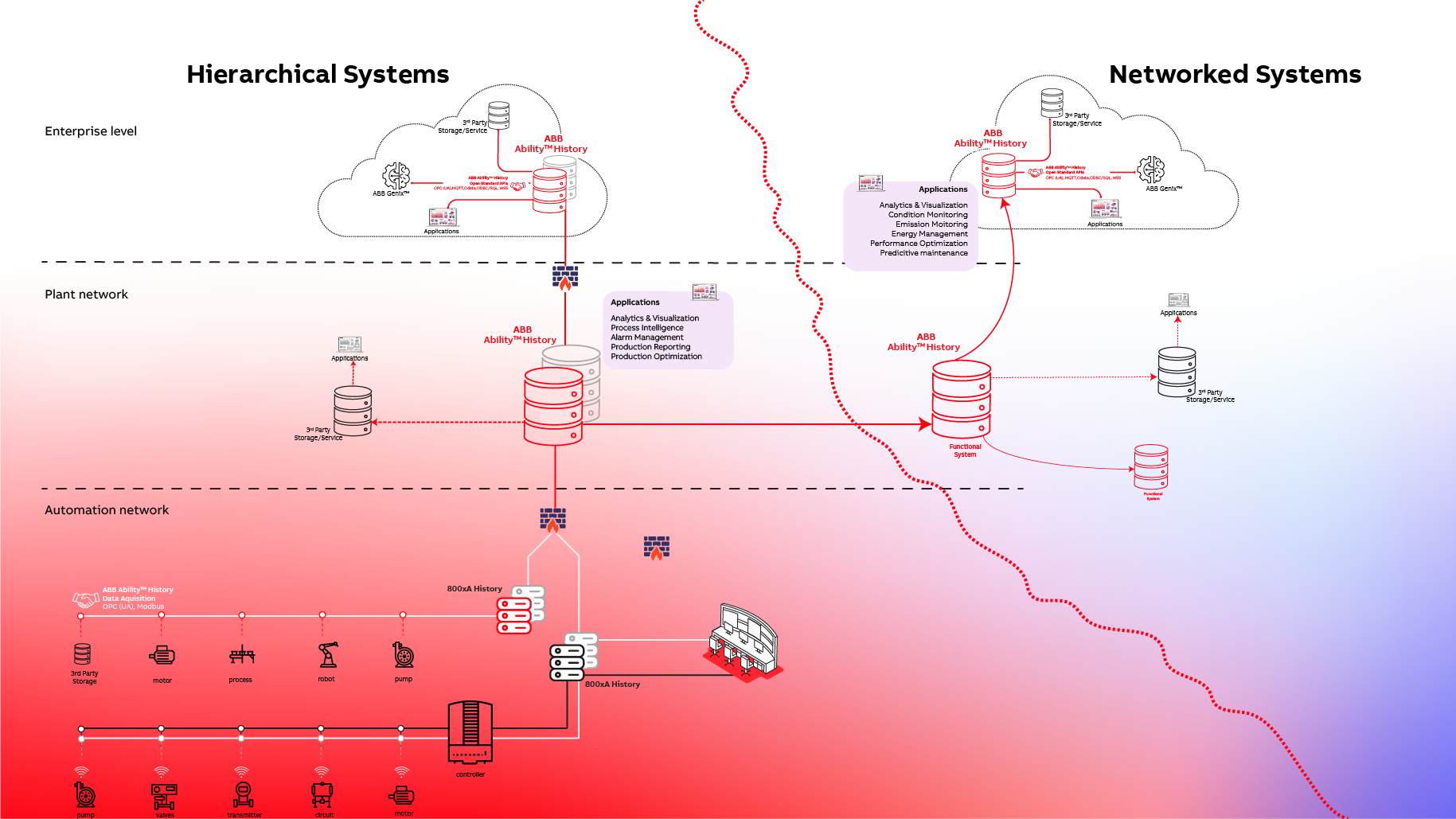
Engineering work to establish the connection between 800xA History and ABB Ability™ History is minimal due to rule based Netsync configuration. Tag/Variables can be replicated, and data, as well as the OPC events feed in real-time to upper-level systems. This enables the Automation Extended to enterprise-level data and application platforms.
Updated about 13 hours ago