
Lifecycle support
ABB Ability™ History is delivered in controlled versions called releases that are numbered with major and minor version number, e.g. 4.3 means that the major version is 4 and minor is 3. A released version can be supplemented with a binary compatible feature release that is indicated with dash and number, e.g. 5.0-1. Cumulated bug fixes are delivered as service releases that are named with SR and number that is incremented with each service release, e.g. 5.1 SR3 is the third service release to 5.1. Individual bug fixes can be delivered as hot fixes on request to meet the business requirements.
So called Continuous Integration and Deployment (CI/CD) pipeline was introduced at the beginning of 2019. In CI/CD new version is introduced periodically and it may contain new features as well as bug fixes and it is always replacing the previous version, and it may be binary incompatible with the previous version. Currently the release cycle for the CI/CD pipeline has been 3 months, i.e. one quarter of an year. CI/CD deliverable is called Stable Build.
A released software version has different life-cycle phases that are defined as follows:
| Life-cycle phase | Description |
|---|---|
| New features | New features are developed to CI/CD pipeline and all known bug fixes are included. |
| Active | Testing is continuously performed and feedback collected from installed systems. Bugs are fixed and delivered as service releases. |
| Classic | High priority bugs are analyzed and tried to fix on request. |
| Limited | In case of critical bugs, best efforts are used to find a workaround or fix. |
The picture below is showing the life-cycle status of the released versions and when it has been in active phase.
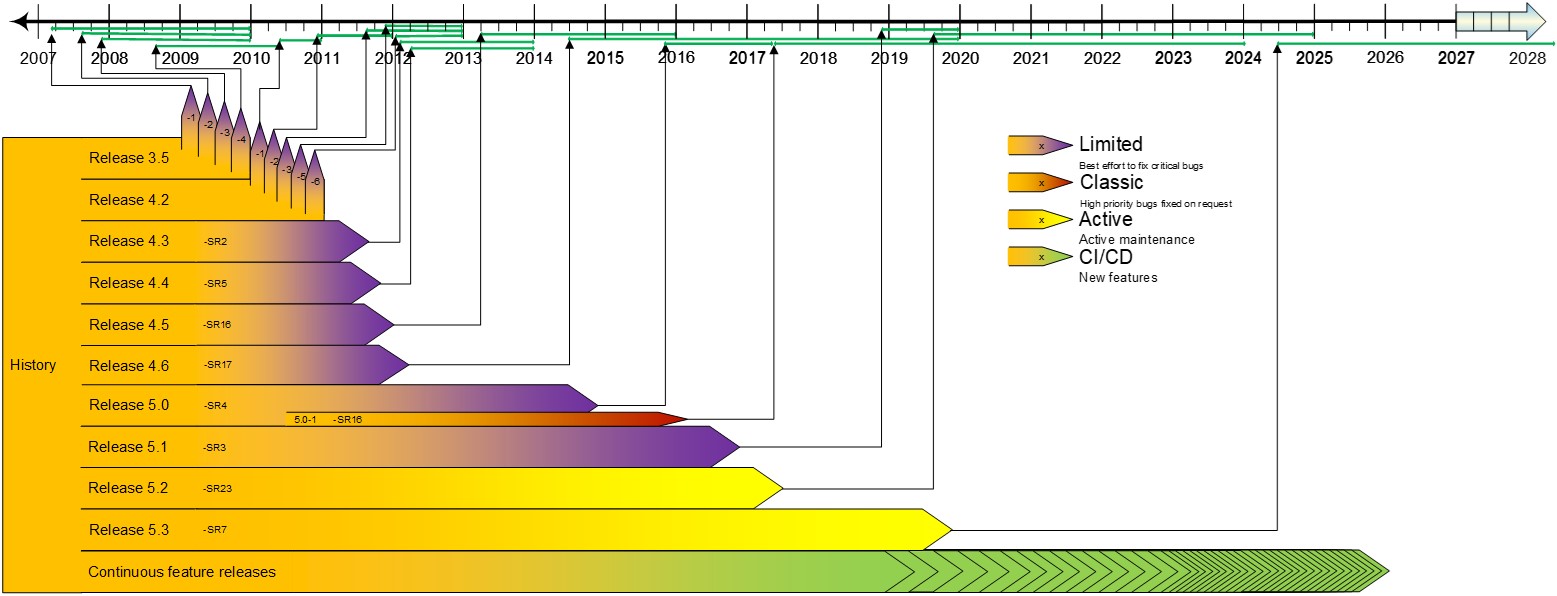
Release history and life-cycle status
ABB Ability™ History 5.2 is and 5.3 is planned to be a long term supported version that will be available at least 10 years from the release date. Due to changes in the hosting operating systems or other technical reasons it may be replaced with another long term supported version that will be backward compatible. Long term supported version is aimed for system products or other solutions where the possibilities for software upgrades are limited.
Use cases where new features are preferred shall always use CI/CD version.
Updated 6 months ago