
Installing History Server – Single Node System
This article will guide you on how to install a standalone History Server (no redundancy support) on a Windows environment
Checklist to be verified before start of installation
- Recommended Hardware Configuration is available. [Preferred to have dedicated drives for Database and Backup.]
- Dedicated Network adapters are available.
- Database Disk Drive should be formatted with 64K Block Size.
- Indexing should be disabled for the Database Drives.
- Add database and backup directories as exclusions to the possible AntiVirus software
- Open firewall for incoming TCP/IP port 443
- Installation should be performed with the user having Administrative privileges.
Install History Server
Download PackageDownload the latest History software from ABB Ability™ History Downloads and copy to your local drive and extract its content to a separate folder (e.g. C:\DVD).
The software download is available only from ABB intranet.Installation through Network share is not supported.
Refer:
Installation on Windows
Installation parameters
Add User to Windows Vault
Add user and its credentials for CPIMS/ADMIN and CPIMS/DBADMIN to windows vault so that the same can be referred in the installation command in order to avoid passing the clear-text password.
NoteMake sure that the users you are adding to the vault is part of local admin group and proceed with installation by log in to the system with the user you are passing for CPIMS/ADMIN
For easy understanding, in below commands the same user 'testadmin' is considered for both CPIMS/ADMIN and CPIMS/DBADMIN, but in production there can be different users for 'CPIMS/ADMIN' & 'CPIMS/DBADMIN' and the below command can be replaced with the corresponding users.
cmdkey /generic:CPIMS/ADMIN /user:testadmin /passEnter the password for 'testadmin'
cmdkey /generic:CPIMS/DBADMIN /user:testadmin /passEnter the password for 'testadmin'
For Domain UserIn case the user is part of a domain, make sure to add the user to local admin group and pass <domainname\username> in above mentioned commands
e.g. cmdkey /generic:CPIMS/ADMIN /user:MyDomain\testadmin /pass
Install Command
In an elevated command window navigate to the folder where the media is extracted (e.g. cd C:\DVD) and run the below command after altering the parameters within "<>" or you can copy the command from example which is covered in below section.
*cmd /s /c ""Project CPIMS\Install_Server.bat" /DBSIZE High /DATAPATH "<DataBaseDriveLetter>:\RTDBData" /APP_ROOT "<DataBaseDriveLetter>:\Application" /TZ "<MyTimeZone>" /DSN "<ComputerName>-RTDB" /NETFX "" /LEAN:2 /BACKUP_ROOT "<BackupDriveLetter>:\" /NOBACKUP:0 /INSTALLATIONTYPE "1" /ADMINUSER " *CPIMS/ADMIN" /DBADMINUSER "*CPIMS/DBADMIN" /ADMINPASSWORD "*" /DBADMINPASSWORD "*" /NODETYPE 1"*where
DataBaseDriveLetter - The drive which is decided for data for e.g. "D"
BackupDriveLetter - The drive which is decided for Backup for e.g. "E"
MyTimeZone - The time zone in which the system is running e.g."Asia/Kolkata" (note: This parameter must match with the regional setting of the computer)
ComputerName - Pass the actual computer name "Project CPIMS" style DSN
Example Standalone Installation command
Here is an example for silent install of a standalone RTDB server, considering 'D:' as database driver and 'E:' as Backup drive and 'Asia/Kolkata' as the time zone.
All the available installation parameters are listed in the chapter "Installation parameters
".
cmd /s /c ""Project CPIMS\Install_Server.bat" /DBSIZE High /DATAPATH "D:\RTDBData" /APP_ROOT "D:\Application" /TZ "Asia/Kolkata" /DSN "%ComputerName%-RTDB" /BACKUP_ROOT "E:\" /NOBACKUP:0 /INSTALLATIONTYPE "1" /ADMINUSER "*CPIMS/ADMIN" /DBADMINUSER "*CPIMS/DBADMIN" /ADMINPASSWORD "*" /DBADMINPASSWORD "*" /NODETYPE 1"This process will verify the time and ask for the user confirmation, you can acknowledge and proceed if the time zone and time is correct. Go through all the prompt from Installation command window and provide acknowledgement accordingly.
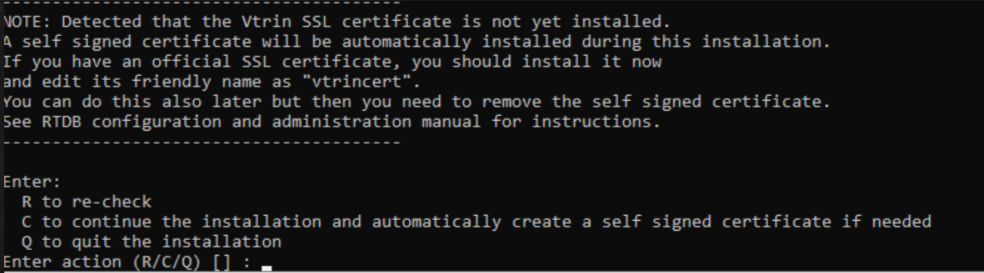
If the Vtrin SSL certificate is not present already (which is true in this case), there will be a prompt as shown in below image. You can proceed by providing 'C' in the option to continue the installation by installing the Self signed certificate. If there is already a SSL certificate available from the customer you need to install the certificate and edit the Friendly Name of the certificate as VtrinCert and provide option 'R' so that the installer scans the certificate store again.
There are some cases where during the installation process the system requires restart. The install script will try to postpone it to the end of installation, if the reboot is mandatory then the install script records that in console output as well as the install logfile and exits the process. Based on the logged output, the user has to initiate the reboot OR reboot and rerun the same command again in order to complete the installation.
Installation Log
The installation progress is displayed in console and also its stored in a logfile APP_Install_RTDB_Project_YYYY-MM-DD.log in the path "%userprofile%\ABB Oy\Log". It is advised that the user goes through this log file for error codes before starting RTDB. The installation reports the success/failure with the process exit status.
- '0' means success
- 3010 means that the installation was successful but a reboot is still needed
Any other code apart from the above mentioned, then there is a failure.
Updated 9 months ago