
Success Story - Industrial Digitalization Transformation
ABB ABB Ability™ History Industrial Data Management Solution

Background
A heavy industry company is collaborating with ABB in a strategic digitalization partnership. The objective is to evolve towards an autonomous facility where data-driven operations enhance efficiency, optimize process performance, and promote sustainability. Achieving this transformation requires seamlessly integrating cutting-edge technologies into the existing infrastructure while ensuring interoperability and a smooth transition to next-generation systems.
“Process industries rely on real-time, high-volume data streaming from thousands of assets and processes across multiple facilities. However, increasing data availability alone is not enough—structured, high-quality data must be accessible beyond the OT layer to unlock the full potential of digital applications, AI-driven insights, and enterprise-wide analytics.”
Partner company sites have relied on ABB Ability™ System 800xA Information Management (IM) for local data storage, providing operators with historical process insights. System 800xA Smart Client enabled data visualization for office network users. This setup has delivered stable, local, cost-effective data management with minimal engineering overhead. Over time, advanced automation solutions—such as Quality Control Systems (QCS), switchgear and energy system integration, and ABB Ability™ Expert Optimizer— have helped improve operational efficiency.
Advanced process control (APC) solutions were implemented to further enhance performance, improve process stability, and reduce resource consumption. This success led to similar APC deployments at additional locations. Beyond APC, ongoing initiatives include production planning and optimization, piloting of soft sensor to provide virtual predicted values, and more.
Challenges
Despite these advancements, several critical challenges remained:
- Data Accessibility Beyond OT: A secure, scalable platform was needed to make operational data accessible across the enterprise for advanced analytics, reporting, and self-service data exploration.
- Decouple Core Automation Systems: A strategic need emerged to decouple core automation systems—designed for high availability and security—from platforms that enable rapid deployment of applications, AI models, and data visualisation tools.
- Future-Ready Infrastructure: Inspired by industry initiatives like NAMUR Open Architecture (NOA) and Open Process Automation Forum (OPAF), the company recognised the need to prepare for next-generation technologies while maintaining operational integrity.
Strategic Goals
To address these challenges, our goal is to establish a robust data management foundation that seamlessly integrates across all layers of the solution stack. This infrastructure must be cyber-secure and allow controlled access to data subsets by ABB and third parties for AI applications. By creating a holistic infrastructure, we aim to standardize the consumption of Operational Technology (OT) data on the Information Technology (IT) layer.
The solution also needs to be implemented by adding capabilities to the existing installed base - enhancing it while at the same time making it future-ready to adopt and host new solutions. This includes writing back from applications and models, executing advanced models such as APC and Soft Sensors.
“Training, configuration and validation of advanced models for these solutions will be done in the IT area but then will be deployed in a controlled way and used in the OT layer - without disrupting or impacting the OT systems.”
This approach will facilitate more sustainable and efficient production processes while reducing system complexity. This will enable value-added applications and functionalities, leading to more sustainable and efficient production processes and reducing the effort required to build systems from subcomponents and integrated equipment.
1. DataOps Platform Deployment
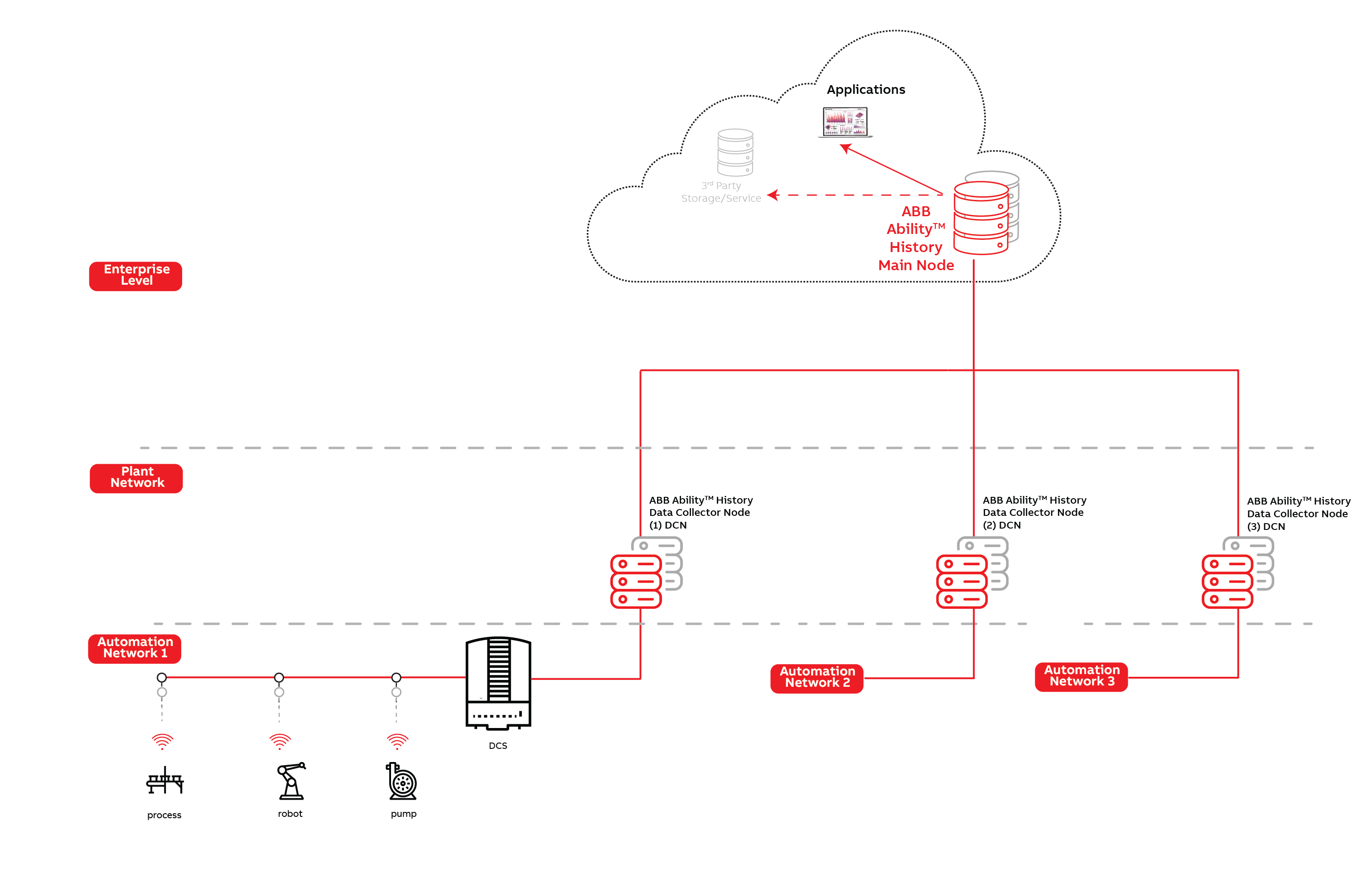
Our immediate focus is on setting up a DataOps platform based on the ABB Ability™ History industrial data management solution. This involves deploying data collection nodes (DCNs) from the DCS and synchronizing data to upper levels, and then selecting the data that is sent from the main node to the Cloud app.
The ABB Ability™ History platform will serve as a central data repository for all applications, ensuring that data is accessible at all levels.
As a first step, time series data and events are collected from the ABB Ability™ System 800xA DCS, but the intention is to add additional data sources in both OT and IT eventually. As an example, there are currently more than 1500 vibration sensors mounted in the plants sending data via 5G, which could be added to the same ABB Ability™ History.
Despite the preparation required to create the data collector nodes for about 20,000 tags per site, the installations at both sites have been smooth. In less than one hour, each respective site’s project team could see the data flowing from System 800xA to DCN, from DCN to the main node and from the main node to the Cloud. With the second site, the SAT is planned soon, initial verification tests have been very successful.
2. Process Historian Migration & Enterprise-Wide Application
The successful establishment of seamless data flow from the sites means the customer can start using other DataOps functionalities of the ABB Ability™ History platform for further data processing, information modeling, calculations and dashboarding. Adding the ABB Ability™ History–based applications for extended QCS profile measurement, drive performance monitoring, and asset performance would be low-hanging fruits as well. The company already has quite a mature energy management system.
In the mid-term, the plan is to migrate the existing process historians at the first two sites (x4) to the latest System 800xA History, replacing data collectors and eliminating the manual effort of defining the tags. This upgrade will enable direct DCS data synchronization to upper levels, streamlining data management processes.
Our long-term vision is to implement enterprise-wide real-time continuous monitoring of process performance. This will include APC and Control Loop KPIs, soft sensors and other potential applications such as production tracking, production planning, and optimization. By achieving this, we aim to continuously optimize performance across the entire enterprise.
Furthermore...
By establishing a solid data management foundation and leveraging advanced technologies, we believe our partner will be able to drive significant improvements in overall profitability. This holistic approach not only meets current needs but also paves the way for future advancements in the industry, including next-generation process automation systems, edge and cloud computing, advanced analytics, and AI.
“The implementation of the reduced scope with ABB Ability™ History and the Data Collector Nodes has been a very smooth and great project, thanks a lot to our fantastic project leader and technical team in Finland. Both the delivery team and R&D have collaborated to deliver the project, and also fix and improve the product where needed. Superb collaboration! “ - Thomas Andersson, Account Manager
Updated 8 months ago