
Process Information Management Systems (PIMS)
Process Information Management System (PIMS) plays an important role in a manufacturing enterprise’s application architecture by creating a common repository of plant information. PIMS provides a holistic view of the plant and assists in making a data-driven decision. By equipping users with comprehensive information on the whole plant, PIMS helps to identify performance gaps and improvements to increase plant operations efficiency and service delivery. Modern PIMS is a multi-level hierarchical system and open data platform with numerous integrations with other systems that provide services to various stakeholders and user roles in a secure manner.
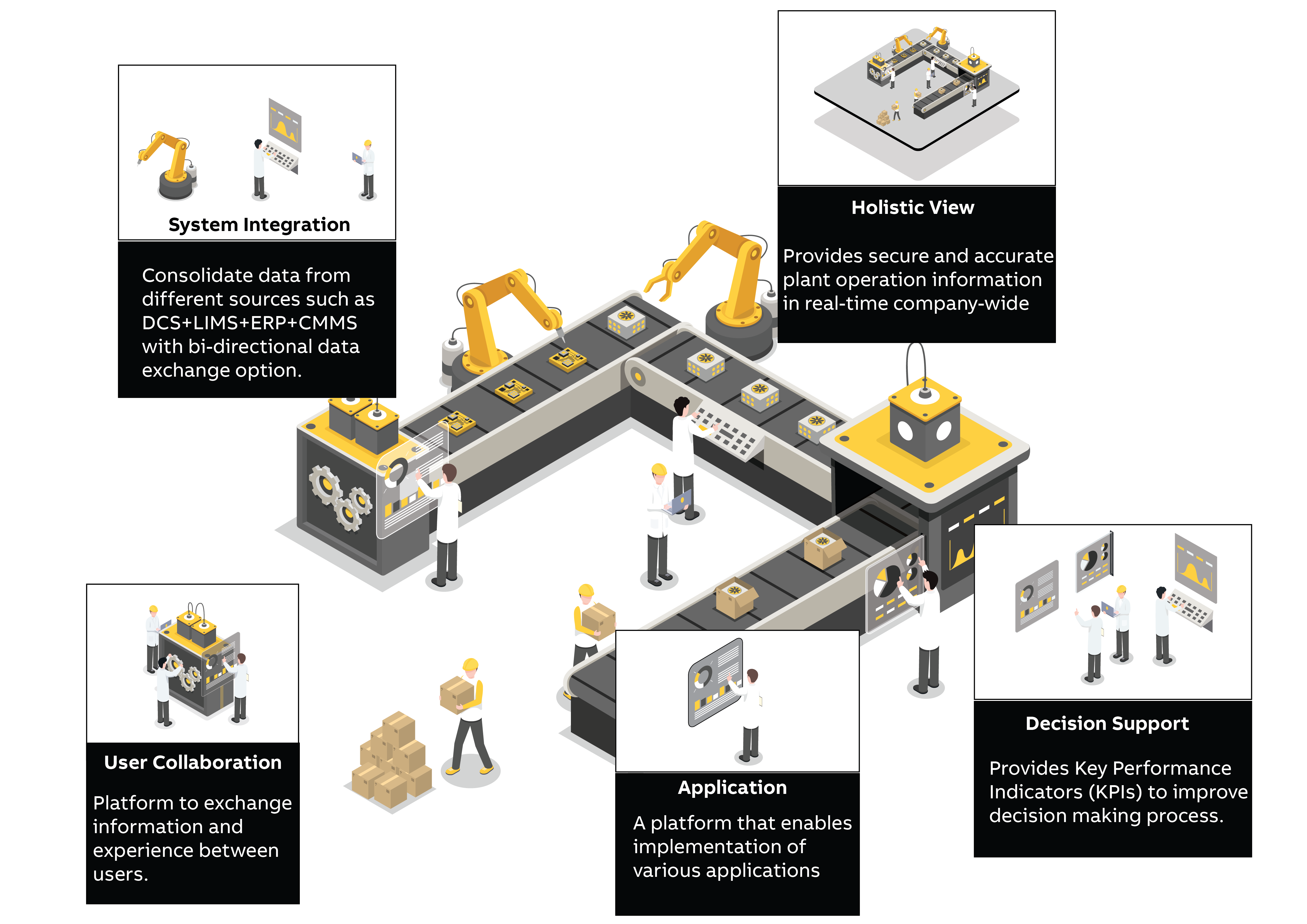
Data Platform - Holistic view to plant operations
The primary purpose of PIMS is to be an open data platform for various purposes. It enables data ingestion, processing, storing, modelling, analytics, delivery, and security. All kinds of data, and especially time series data, can be stored in PIMS and delivered to those who need the data. Ensuring data quality in all its aspects is crucial for plant operations. Reading and writing the data with standard APIs and built-in security enables the continuous development of services to enhance operational efficiency.
Communication between devices, systems, applications, and users can be bidirectional enabling flexibility in reading, writing, subscribing, and notifying on data changes. PIMS is an information system, but many applications need writing parameters and setpoints back to devices and control systems to optimize operations. This is possible even from some Machine Learning (ML) applications running in the Cloud and the setpoint is transferred through several systems layers and security zones down to the control network and then finally to the controller.
Decision support
PIMS supports decision-making at multiple levels from plant floor to top management with accurate data on plant operations containing long histories, real-time current state, and many times also the predictions of the future. With accurate data, the improvement areas can be identified and service delivery focused on the most urgent needs.
Applications
In addition to the basic process monitoring, controlling, alarm management, and reporting functionalities, PIMS is an application platform that enables the implementation of various applications to support plant operations. Examples of such applications are OEE (Overall Equipment Effectiveness) and lost time reporting, online process analytics and SPC (Statistical Process Control), production reporting, condition monitoring and predictive maintenance of production equipment, continuous improvement management, emission monitoring, and many others. The tooling (iLCAP) enables the efficient development of applications that are tailored to meet the user's expectations on functionalities as well as experience.
Systems Integration
PIMS is important but still, just one system an industrial company uses in its business operations. In addition to the control system integration, PIMS needs typically to be integrated with MES (Manufacturing Execution Systems) such as production planning, tracking, quality management, ERP (Enterprise Resource Planning), CMMS (plant maintenance management), and many other functional systems. The data exchange is many times bidirectional and PIMS may have an active or passive role in the data transfer.
User Collaboration
PIMS is not only for collecting and refining the process data, but it is also a collaboration tool for the users. It may contain various diaries for production, development, continuous improvement, and maintenance notes and tasks, and knowledge banks to exchange information and experience between users and organizations. The benefit of implementing these collaboration functions in PIMS is the seamless integration of the process, production, and maintenance data with the user-written notes.
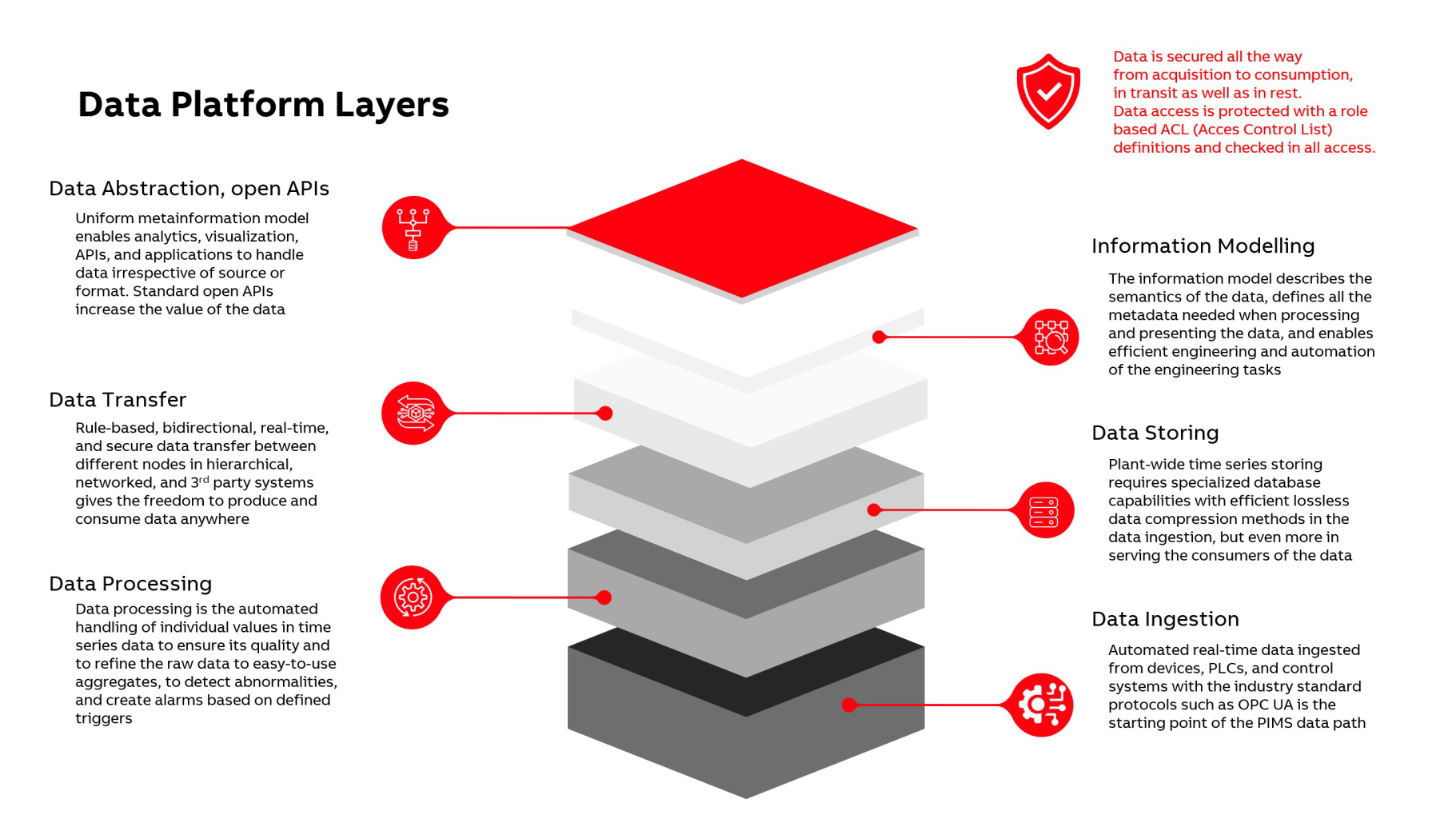
Data platform layers
Data ingestion
Real-time data ingestion is the process of collecting and transferring data from source systems in real-time. Constantly monitors transactions or redo logs and moves changed data without interfering with the database workload. Real-time ingestion is essential for time-sensitive use cases, such as stock market trading or power grid monitoring, when organizations need to rapidly react to new information. Real-time data pipelines are also vital when making rapid operational decisions and identifying and acting on new insights.
Everything starts with data collection. Collecting and moving data from and to devices is still considered a key challenge in IoT solutions. PIMS collect and distils data from digital equipment, control systems and PLCs that are connected to process devices using industry-standard protocols such as classic OPC (DA, HAD, AE), OPC UA, and Modbus. It consolidates plant data into one single source and promotes plant operation efficiency.
Often, PIMS is the master of communication handling the subscriptions, retrieval and writing of the values. Some devices provide protocols such as MQTT and AMQP to publish their data and PIMS can subscribe to defined topics for data acquisition as well. It also provides server-side protocols, especially classic OPC and OPC UA, OData, WSS, and some other proprietary APIs, to receive the data from devices and other systems.
In addition to control systems and devices, the data source can also be an online or offline analyzer, a human such as a laboratory engineer, or some other system or application. While the control systems are producing chronological time series data, the other sources may produce data in non-chronological order.
Data processing
Data processing is the automated handling of individual values in time series data to ensure its quality and to refine the raw data to easy-to-use aggregates. The action often includes value preprocessing, event/alarm detection, validity and substitute handling, and online aggregation. A modern data platform allows native processing of structured, semi-structured, and unstructured data at a massive scale, developing applications.
For example, it may enable the processing of raw data to convert to engineering units and/or to calculate aggregate such as Fast Fourier Transformation (FFT) to make it easier for applications to handle. It also maintains the information on the representativeness of the data that enables for instance describing the reliability of the numbers in reporting. Data processing that is defined based on an information model makes data engineering efficient and fully automated operations (See information model for more).
Alarm and event management
PIMS typically records alarms and events from the control systems, safety systems such as fire and gas detection, and devices for plant-wide long-term storing and alarm management. It may also be used for active alarm management for the control systems so that the operators can acknowledge the control system alarms/conditions from PIMS and acknowledgement is transferred to the controller e.g. with OPC UA.
The other function is the alarm detection at the PIMS level for the raw signals or various calculated signals or for the combined conditions on the production equipment or the whole plant. Alarms may have an active workflow with acknowledgements and they can trigger notifications to be sent to users.
Data storing
With an exponential demand for handling the number of signals and data recoding cycles, the time series database is the core proposition of PIMS. It provides efficient lossless data compression methods to save resources and fast data access. It enables online backups of the data with the ability to store long histories of raw and aggregated data with an automatic database.
Data transfer
PIMS systems are typically hierarchically constructed from multiple levels due to cyber security and functional requirements. Efficient, secure, bi-directional data transfer between the different system layers is the key enabler to implement functionalities. While a PIMS system typically contains tens of thousands of signals, rule-based configuration for defining which data is transferred to which direction is crucial from an engineering perspective. Data transfer ensures also the consistency of the data at different levels with automatic backfill functionalities. Sometimes the data transfer is configured to perform transformations such as from an information model to another one, change property names, or even data types.
Information modelling
Information modelling increases the value of the data. The information model describes the semantics of the data, defines all the metadata that is needed when processing and presenting the data, and enables efficient engineering and automation of the engineering tasks. The traditional time series data model is a Tag/Variable that describes the metadata of a signal including e.g. identification, place in the process hierarchy, measurement range, engineering unit, data acquisition definitions, used protocol, and a lot more.
The next level in the information model is the equipment model that contextualizes the signals and enriches the semantics to construct so-called digital twins of the physical devices, production lines, and processes. The equipment model can be introduced above the Tag/Variables e.g. in a typical brownfield environment where the control systems are the main source of the data. However, the full power is achieved when the equipment model is used as the native modelling tool from the devices throughout all the system hierarchies, and all the systems functions, calculations, visualizations, and applications are built against the equipment models.
Data abstraction
Data abstraction provides a uniform meta-information model that is used by all the public APIs, visualization, calculations, and other tools while accessing data. It doesn't matter what is the source of the data or storing format, applications and business tools can utilize the data in an integrated manner and combine it in reporting etc.
Data security
Cyber security is highly important in PIMS as well as in other industrial systems. Industry standards for cyber security shall be followed and in effect in system configuration, data transfer, exposed APIs and data protection. It is recommended to perform cyber security assessment and vulnerability testing for the PIMS system before starting the operational use and periodically while using it.
PIMS support user authentication from multiple ID management systems. APIs require user authentication and certificate-based authentication in case of systems integration. All data is protected with role-based ACL (Access Control List) definitions and checked in all access.
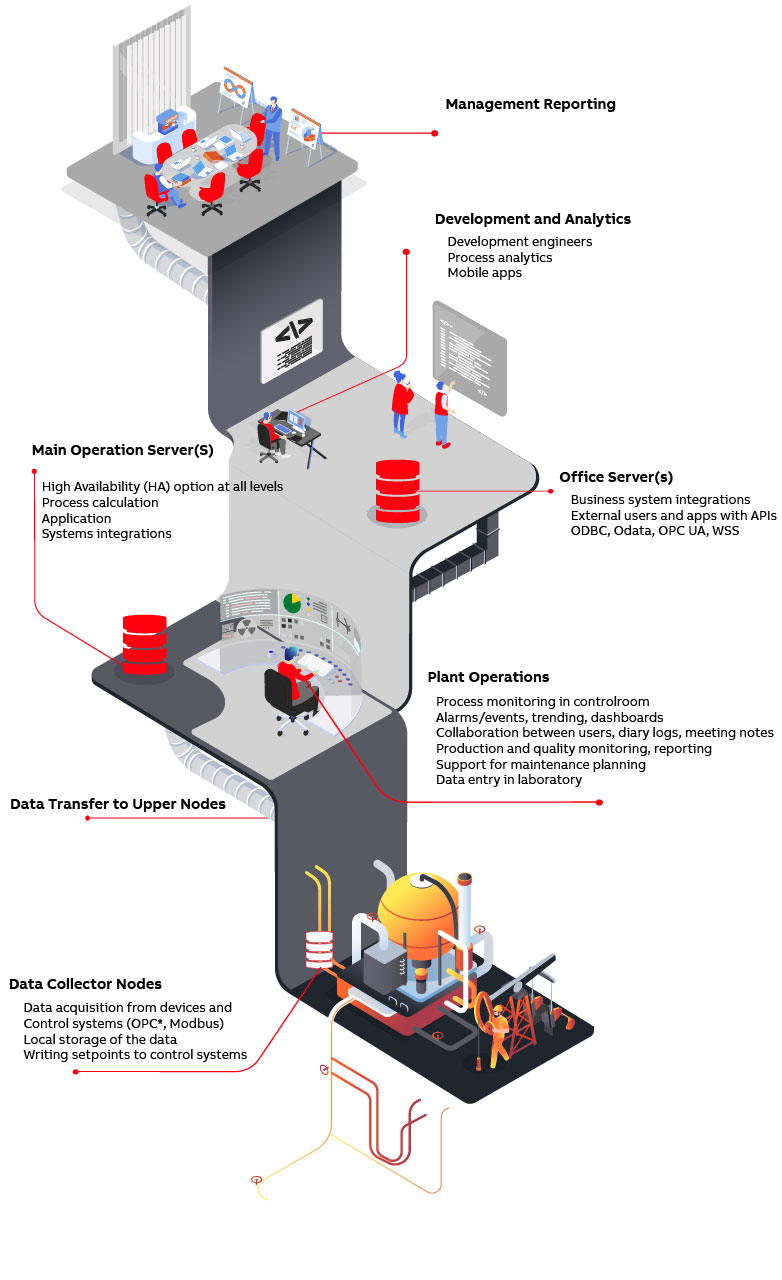
PIMS - Hierarchical system that supports whole plant operations
PIMS system is constructed from multiple hierarchical or networked nodes that all can act as small independent PIMS, but together they conform to integrated plant-wide PIMS. All PIMS nodes are connected with a secure bidirectional communication protocol. Connections are created from the more secure network zone to the less secure so that only port 443 needs to be outbound open. PIMS nodes are authenticated against each other with certificates.
Data collector nodes are PIMS nodes installed in the control network for establishing data acquisition from devices, control systems, and PLS. Data collector nodes are connected to production line or plant level PIMS nodes that can be further connected to enterprise level PIMS nodes or other special function PIMS nodes such as energy management or condition-monitoring PIMS nodes. Data is transferred from DCNs to factory and enterprise-level systems in close to real-time with consistency control, and automatic backfilling in case of disturbances.
All PIMS nodes contain their own database and they can provide APIs, act as data acquisition nodes, run data processing, storing, calculations, visualization, and host applications.
Data entry from laboratory
In addition to automatic data acquisition, typical PIMS contains human-entered data such as laboratory analyses. Human-entered data can be stored in any PIMS node and is handled similarly to other time series data.
Calculations
The value of PIMS is to refine the raw data to something that supports decision-making. This may require calculating soft sensors and various complex things that are further calculated to Key Performance Indicators (KPIs) that are easy to understand by the plant operations. Calculations can be scheduled by time or they can be triggered by events of time series data changes. Calculations may use extensive amounts of time series data as source values and event-based calculations are using dynamic time periods that are defined by the events. Close to real-time calculations in industrial plant scale require high performance from the PIMS database and tooling.
Sometimes data must be updated later, due to bad sensors or delayed data transfer from other systems and this requires triggering recalculations of all the calculations that are using the modified data as a source. Many optimizing calculations and future predictions may also be recalculated frequently over long periods.
Production event management
Production events can be triggered by a control system or some other PIMS-integrated system, calculation, or application. An event, sometimes called an event frame, is a flexible data model that has any number of attributes of any data type and they can be stored without introducing them in advance. Efficient indexing of the events by any attribute enables rich application functionalities.
An event be can described e.g. the product of a production line. Calculations and applications can store further attributes to events, e.g. the amount of raw materials used to produce the product or quality and production conditions.
Visualization
Visualization (UI) of the data is perhaps the most important function of PIMS because the whole data path is converted to human understandable information to support his/her decision-making. There are typically many different stakeholders using PIMS. They shall have their role-based UI applications that best fit their needs from control room environment to mobile laboratory data entry and management reporting.
Nowadays the standard UI tool is a web browser. PIMS UI may be a single-page application (SPA) with thousands of dashboards for various users, but it can also have a web page type of layout and dashboards optimized for mobile use. Many of the dashboards are highly interactive and enable data entry functionalities.
Reporting
Reporting is a special functionality of the data visualization that enables storing visualization in document format e.g. for sharing with stakeholders that don’t have access to PIMS such as authorities or end customers that need quality reports of the delivered products. Reporting can happen interactively by a user or it can be automatically scheduled.
Company business reporting tools such as MS Power BI and Excel are supported with PIMS standard APIs ODBC/SQL and OData that enable retrieval and maintenance of data.
Data publishing
PIMS is an open system that provides data to those who need it as well as acts as the central storage for data that someone needs to store. Industry-standard open APIs (Application Programming Interfaces) such as OPC UA, ODBS/SQL, OData, and WSS are used to integrate systems, 3rd party tools, and business applications with PIMS. Data extraction from PIMS UI to Excel, CSV and JSON files for further analyses serves users’ daily needs.
PIMS can also act as an active data publisher and push the data to e.g. MQTT or AMQP for further processing. Efficient rule-based configuration is appreciated by the engineering.
High availability
Many PIMS systems have mission-critical roles in plant operations and that is why all PIMS nodes support high availability with online redundancy against any single point of failure. Data acquisitions and system-to-system communications can be redundant and support backfilling data from system to system in case of communication breaks.
ABB Ability™ History
ABB Ability™ History provides complete functionality to implement mission-critical PIMS systems for various industries and utilities. There are numerous installations of ABB Ability™ History-based PIMS in Pulp and Paper, Metals, Chemicals, Oil and Gas, and Power industries across the World.
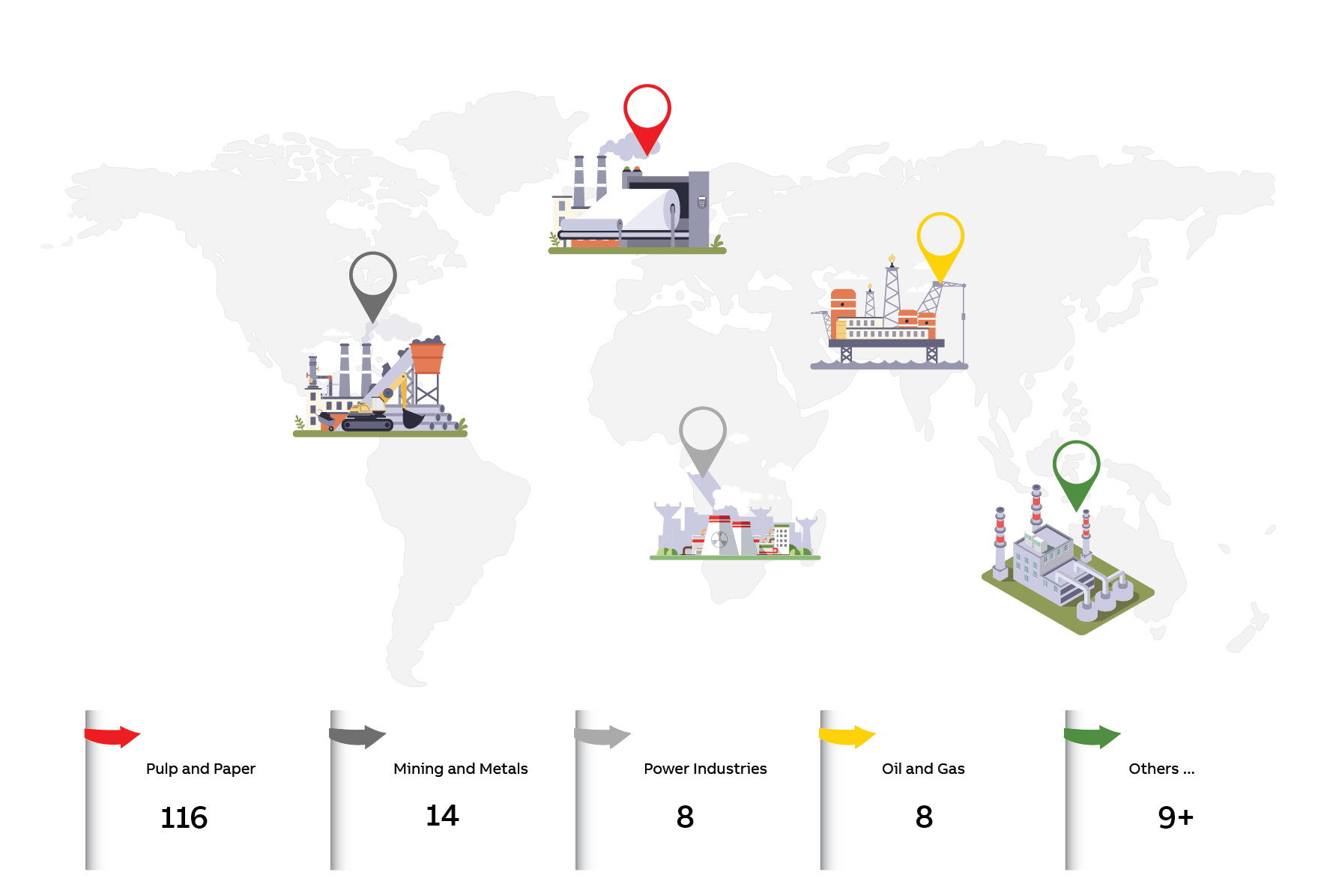
ABB Ability™ History based PIMS installations in Pulp and Paper, Metals, Chemicals, Oil and Gas, and Power industries across the World
Updated 7 months ago