
High availability
ABB Ability™ History supports high availability configurations where two history nodes replicate data between each others and form one high availability database.
Concept
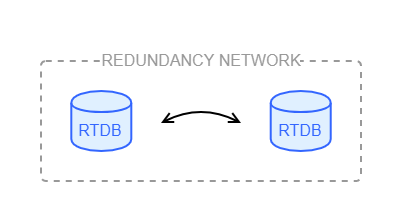
Two History nodes are connected with a high-speed network to replicate data online and check their data consistency with each other. Nodes are equal - no primary and secondary relationship.
System requirements
Requirements to run a high availability system:
-
It is recommended to have a dedicated, isolated 1GB network between the nodes for redundancy communication. The redundancy communication is not throttled and sometimes the load is significant and may cause disturbance to other traffic. In physical systems the idea would be a direct network cable between the computers, in virtual systems similarly protected and shielded network must be available. Having UDP and Multicast communication would be desirable, but TCP/IP can also be used (but its overhead is larger).
-
The operating system features MSMQ-Multicast and MSMQ-Server need to be enabled to enable PGM protocol (Pragmatic General Multicast). However, this is not needed if TCP/IP communication is used instead (TCP/IP will have larger overhead).
-
System clocks in redundant nodes must be synchronized and not to differ more than 1 second from each others.
-
Redundancy requires more CPU power in order to maintain the CRC indexing during writing data, and to manage replication of data between the computers. The actual increase is not large, but in order to achieve the same storing speed as for non-redundant systems, especially the single core processing power is important because of the additional low level table page locking activity during the data storing.
Redundancy requires also more disk space to store RowModificationTimes and CRC indexes (in CurrentHistory style data, the increase is about 20%, in StreamHistory data, the increase is minimal, less than 1%).
There are not strict requirements for the system resources, i.e. CPU, RAM, and disk IO, but as a rule of thumb, there should be about 50% more resources than what would be enough for a single-node node system. On the other hand load sharing is then potentially providing better performance in redundant configuration. -
It must be possible to exclude the database and backup directories from virus scanner software. Any hardening on top of the operating system installation must not be enforced.
Behavior of the system
Core concepts
High availability in ABB Ability™ History means that two nodes are continuously striving to have the same data available. The redundant nodes are replicating the input data streams to each others to record the same time series histories. To ensure the consistency of the data, separate checking and fixing of the data content is performed continuously.
The redundancy works at the database table level. Each database table can be configured to be redundant and under consistency control or not. If a table is not under consistency control, it is not affected by redundancy at all. Typically in a redundant system most tables are defined to be redundant. To make a table redundant means two things; the table has to have the special index called the ‘Cyclic Redundancy Check’ index (CRC-index), and it has to have the column ‘RowModificationTime’ (RMT), which stores the time when the database row has last been modified.
There are two services that are responsible for keeping redundant data in a consistent state. RTDB-CVMCServer is replicating the input data stream, and RTDB-ConsistencyController is performing the consistency checking and fixing. Figure 7.1 illustrates the components in redundant nodes.
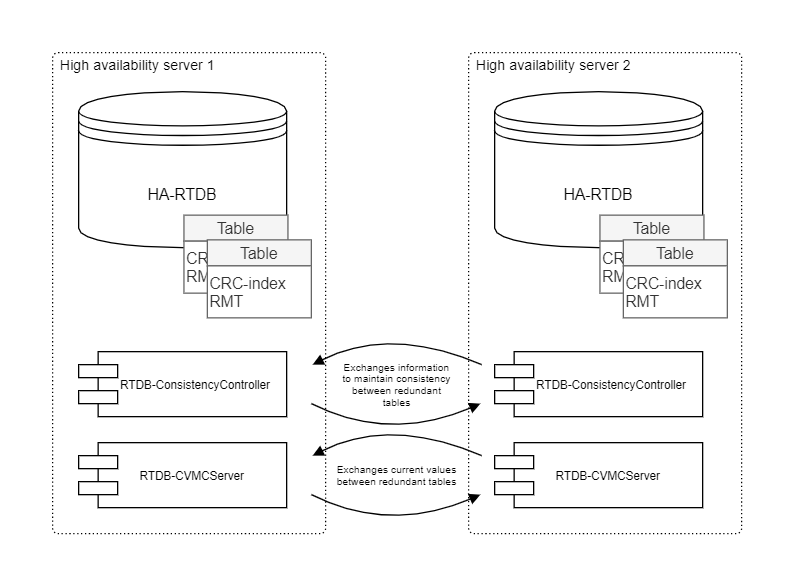
Overview of the components in High Availability RTDB nodes. Data source names for both RTDBs are identical. The setup is symmetrical from the most parts.
RTDB-ConsistencyController and RTDB-CVMCServer can be configured to use different communication communication protocols for exchanging the data (UDP multicasting, Pragmatic General Multicasting (PGM), or TCP/IP). Currently, the High Availability is defined to support two redundant nodes (one-out-of-two), but the architecture is not limiting to have more nodes, e.g. one-out-of-four.
RTDB-ConsistencyController provides some additional services that are needed to support application redundancy. These services are presented in detail in section Services.
Deterministic data production
It is beneficial in a high availability system to be able to produce data deterministically. The ability to do this can reduce the overall load, as data production can be independent in both main nodes, and optimized based on the protocol used to produce data. However, this is often not possible, for example, because the protocol used to fetch data from the original source is based on non-deterministic polling. In the worst-case-scenario, running two non-deterministic data links to collect data from the same data source in redundant servers would produce double the amount of data, and thus affect the performance of the system. From a functional perspective as well, this would be something that is not desired.
In case deterministic data production is not possible, it is better to run the data production only in one node at the time. The redundant configuration provides two functionalities to implement a service to run in one node at the time. First is so called "service group", i.e. the service is controlled by RTDB-ServiceManager and started only in one node. The other alternative it that the service is synchronizing its operation by itself. This concept is called the "master token".
Using the master token, a service can control its operation to do tasks in only one node at a time. All data links that are available in the standard setup (VtrinLink, RTDB-EcOpcClient, RTDB-EventForwarder, and RTDB-TagConsistencyController) are implementing the master token to restrict the production of data in only one node at a time. The nuances of the master token handling are described in section Optimization primitives.
Transparent data access
Clients would like to have transparent data access to the high availability History and automatic changeover to the other node in case of a failure. This transparency can be achieved with two ways:
-
Using Windows Network Load Balancing (NLB) that defines common IP address for the two nodes. (Note that installing NLB is currently not done automatically.) When NLB is installed, the priority is set to define where data is fetched from, if both redundant nodes are available. After installation, the NLB configuration is available in Windows in "Administrative Tools\Network Load Balancing Monitor". The priority can be changed later on. If the primary node is shut down, the context switches to the secondary node but returns back to the primary node when it is started again. However, the current implementation is not able to change the NLB context when RTDB is shutdown without shutting down Windows. In this scenario, the NLB context can be changed manually from the NLB Manager.
-
VtrinLib contains automatic load balancing and change-over functionality in HA configuration. All clients and APIs based on Vtrinlib and connect to one of the HA nodes get automatically informed that there is also redundant node available, and in case of failure the changeover to the other node takes place automatically. There is also load balancing functionality, i.e. when the client tries to connect to an HA node, it may be redirected to a redundant node with lower load.
Optimization primitives
The Master Token is a mutual exclusion lock mechanism that can be used in High Availability systems. An application can request a Master Token by name, and the RTDB-ConsistencyController takes care that only one application instance holds the Master Token (unless configured to allow multiple instances).
Master Tokens are also known as “Services” and they can be fine-tuned using the class "Service". (Available in the 'RedundancyControl' diagnostics display, documented in section Redundancy control displays). It contains a list of the master tokens currently used and the host where the owning application is currently running. There are also four bit-values that affect the behavior of the application.
- "Allow Multiple": When set to true, disables the master token functionality and lets affected services to execute tasks protected by the master token simultaneously. By default, this is set to false for all services.
- "Auto Failback": When set to true, the ownership of the master token is always given to the higher priority node as soon as possible. For example, in case the primary node is shut down temporarily, and because of this, the master token context changes to the secondary node, it would be returned back to the primary node as soon as the primary node has been started, and RTDB services are available.
- "Disable Inheritance": It is up to RTDB-ConsistencyController to provide the master token services. To be able to ensure the atomic behavior, i.e., the task protected by the master token is executed on only one machine at a time, and it has to communicate over the redundancy network with the RTDB-ConsistencyController in another node. "Disable inheritance" defines the behavior in the situation where the RTDB-ConsistencyController in one node loses the connection to the RTDB-ConsistencyController in another node. In this situation, the master token is given for the components in both nodes if the value is false. If the value is set to true, the service continues to run in the original node only. The reason why the instances of RTDB-ConsistencyController could not communicate with each other could be network failure in the redundancy network, hardware failure, or software bug. By default, all other services except for RTDB-TagConsistencyController have "Disable Inheritance" set to false. Configuration of the database, which RTDB-TagConsistencyController is automatically doing, is in some parts relaying the assumption that tags and variables are always created in only one machine at a time, and not while the communication in the redundancy network is broken.
- "Release Requested": This is a request to the application to release the ownership of the master token and go idle or shutdown (the in-detail behavior is application-specific).
Sync Halt provides a mechanism to pause the synchronization of a specified table for a given time period. This is purely an optimization mechanism for data links that are inserting data into the database. Allowing RTDB-ConsistencyController parallel access to the table, while the data link is doing updates, causes non-optimal overall system behavior. This mechanism is used at least in VtrinLink, RTDB-CVMCServer, and in RTDB-TagConsistencyController.
Sync Barrier provides a mechanism to ensure that the specified database table is synchronized to have the same data available in both redundant nodes before continuing the operation. Behind the scenes, RTDB-ConsistencyController raises the priority of synchronization for that table to reach consistency as soon as possible.
Configuration
There are a few places that contain configuration for high availability servers. RTDB.ini contains the following lines.
[General]
ConsistencyControl=ON
This defines that the node is a high availability node.
SimpleConfig contains many low-level settings that affect the functionality and performance of RTDB-ConsistencyController. Most of the settings are such that they should not be changed without a deep understanding of RTDB-ConsistencyController. One parameter that can be changed is MasterTokenTrace (default value 0). Setting this value to 1 starts tracing the master token related information e.g., into the log file: %APP_DATAPATH%\diag\RTDB-ConsistencyController D RTDBData.log
Diagnostics
Log files
The RTDB-ConsistencyController log file is available in %APP_DATAPATH%\diag\RTDB-ConsistencyController D RTDBData.log
Windows event log
The Windows event log is used to log possible PGM errors that could indicate problems in the redundancy network.
Updated 9 months ago