
Hierarchical systems
Industrial solutions have typically hierarchical system structure
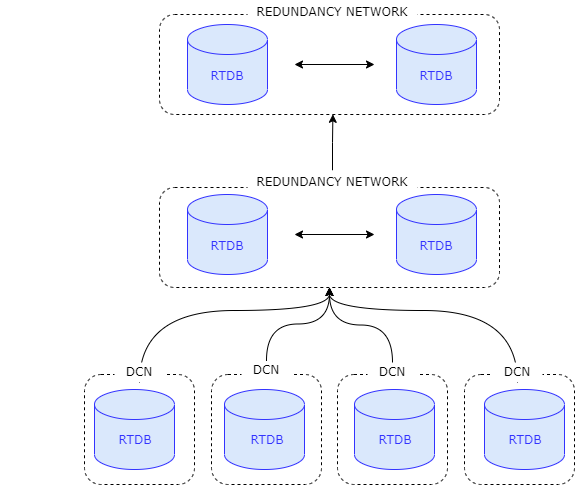
Both manufacturing operations management and IIoT systems are typically constructed from layered architecture where so-called data collector nodes are connected to devices, control systems and other data sources. Nodes can form hierarchies such as production line and factory level and they can then further be connected to upper level computing node, e.g. enterprise level. Typically, lower level nodes transfer data to upper levels as raw or aggregated format. Data collector nodes as well as upper level nodes may contain applications such as calculations and visualization. Applications may produce data that may also be transferred in both directions in the hierarchy and sometimes also written down to control system or device.
Concept
Tree structure is the most widely used system topology. Topology has the following characteristics:
- Parent-child relations are set in installing phase. Data Collector Nodes (DCN) are the lowest level nodes.
- Tag is the object owning the configuration for a time series and TagConsistencyController service is handling consistency and configuration of Tags between layers.
- VtrinLink is the service to transfer time series data between nodes and it is running in upper level node.
- EventForwarder is transferring process events between nodes and it is running in the upper level node.
- Multiple layers are supported, though only two are supported by installer.
- Upper level nodes can be redundant or non-redundant
- Data collector nodes support so called Independent redundancy, having the same data but no online consistency checks. No communication between nodes is needed.
- This concept is only available when Tags and Variables are used to configure database. Networked systems should be used when Equipment modelling has been used.
Updated 9 months ago